
When the World Pauses, Tourism Waits… Then Runs
A perspective on the Middle East travel & hospitality industry.
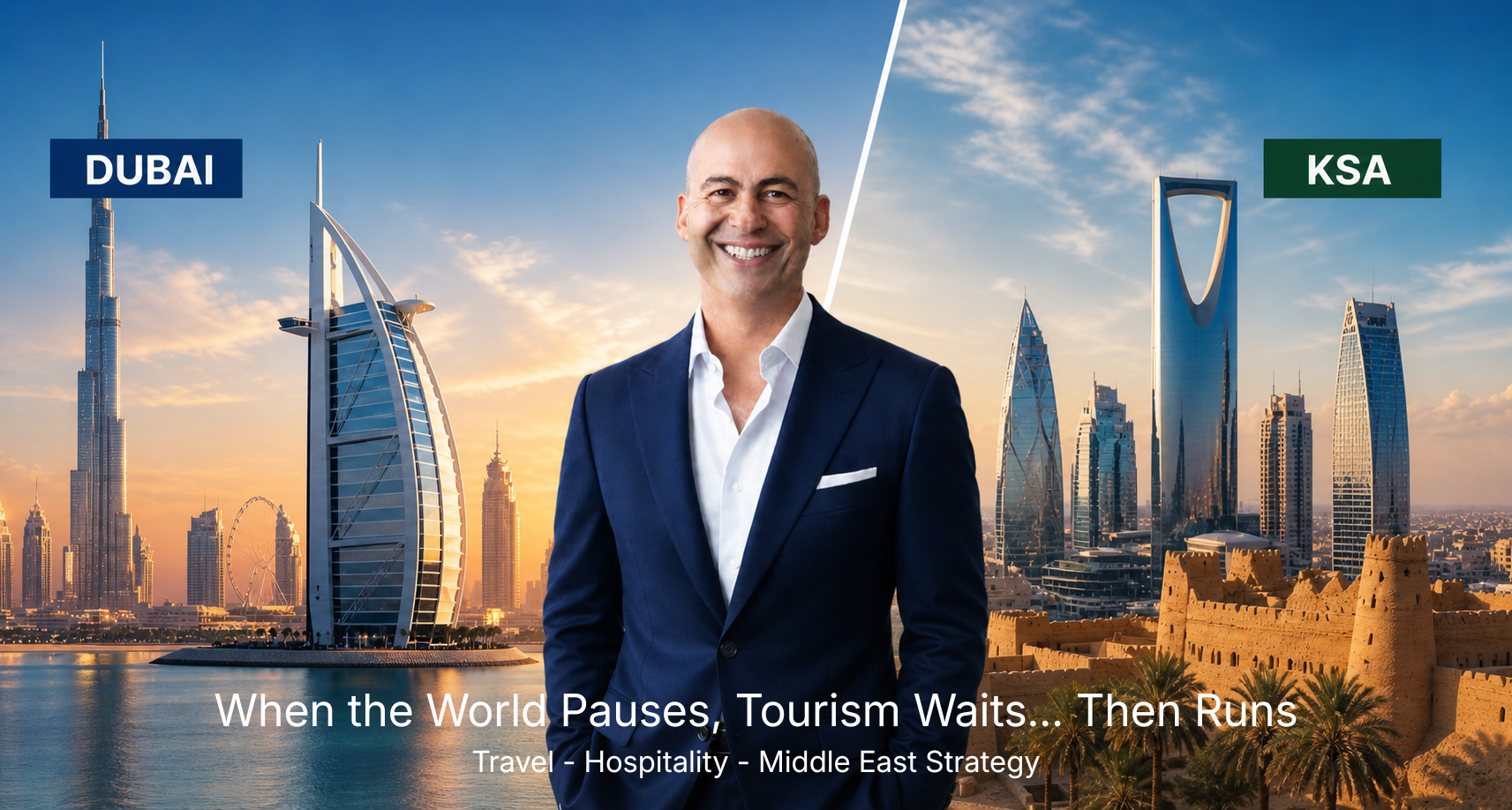
When the World Pauses, Tourism Waits… Then Runs
A perspective on the Middle East travel & hospitality industry.
There's a rule in travel that rarely gets talked about openly:
Tourism is always the first sector to feel the shock, and almost always the first to recover.
Right now, the Middle East is experiencing one of its most significant disruptions in recent memory.
Flights rerouted, bookings cancelled, occupancy rates that were sitting at 86% in January collapsed to under 25% within weeks, daily losses across the region are estimated at over $600 million.
The numbers are real, the disruption is real, but so is the history.
What data actually tells us
The World Travel & Tourism Council projects a decline of 11–27% in inbound arrivals to the Middle East for 2026.
That's between 23 and 38 million fewer visitors compared to what was forecast just months ago.
For context: Dubai welcomed nearly 20 million international visitors in 2023 alone, one of the most remarkable post-pandemic recoveries any destination has ever achieved.
The same infrastructure, the same vision, the same government commitment remains.
What changed is confidence, not capability, and the real damage is never physical, it's perceptual.
Here's what most people miss about travel:
Tourists don't make decisions based on detailed geopolitical analysis. They make decisions based on a feeling.
And when a region appears in the news for the wrong reasons, the entire area gets painted with the same brush, whether or not a specific destination was directly affected.
Dubai's hotels are open, staff are present, the city is functioning, but perception doesn't wait for nuance. This is the industry's deepest vulnerability, and also the clearest signal of where the opportunity lies when conditions shift.
Why the recovery, when it comes, will be fast
Every major disruption in the Gulf's modern history has followed the same arc:
- 2008 financial crisis → Dubai recovered within quarters
- COVID-19 pandemic → Dubai ranked among the world's fastest tourism recoveries
- Regional tensions, 2024 → Demand rebounded sharply once stability signals returned
The reason isn't luck, I firmly believe it's structure.
Geography doesn't change. Dubai and the broader Gulf sit at the crossroads of Europe, Asia, and Africa, a connector that no crisis can relocate.
The infrastructure invested over the past two decades hasn’t disappeared, and the governments involved treat tourism not as a nice-to-have, but as a national priority at the level of economic identity.
Dubai has already announced $272 million in support for its hospitality sector, not to panic-cut prices, but to protect rate integrity and keep businesses ready for the rebound.
That's the thinking of an industry that knows it will be needed again soon.
What changes on the other side
When stability returns, and it will, the travel landscape won't simply reset to what it was.
A few things will be different:
Flexibility becomes non-negotiable.
The travellers who return first will demand it: free cancellation, modular itineraries, last-minute availability, these are no longer premium features, they're baseline expectations.
Trust becomes the new luxury.
Not the biggest hotel, not the most spectacular attraction. The destination and brand that makes a traveller feel certain, certain of safety, certain of quality, certain that their investment is protected, wins.
The events calendar shifts, not disappears.
Major conferences and incentive trips planned for spring are moving to September – November 2026.
The revenue isn't lost. It's compressed into a different window. For operators who are positioned and ready, that compression becomes an advantage.
A note on Saudi Arabia
Saudi Arabia's position in all of this is worth watching closely.
Vision 2030 was already being recalibrated before this year, moving away from spectacle toward a more focused set of priorities: tourism, technology, advanced manufacturing.
The disruption tests those plans under real conditions for the first time.
The Kingdom has something Dubai doesn't: a large domestic market, and the world's largest captive religious tourism audience through Hajj and Umrah. These create a floor that purely international-facing destinations lack.
The timelines will stretch, the ambition won't disappear.
The bottom line
The Middle East is not losing its position in global travel.
It's experiencing what every major destination experiences at some point, a forced pause.
The question is never whether recovery comes, the question is who is positioned to capture it when it does.
The winners won't be the biggest or the most lavish, they'll be the ones who stayed ready, who protected their brand, who built trust when it wasn't being tested, so it holds when it is.
That's not just a prediction about the Middle East, that's a lesson the travel industry relearns every single cycle.
What's your read on how hospitality businesses should be positioning right now? I'd be interested in the perspectives of people on the ground.
Nicolas Frangos 🐬
Disruptive yet Pragmatic Tourism Travel Hospitality Leader
Purpose in Practice - Designing Belonging


Luxxielime Blog